


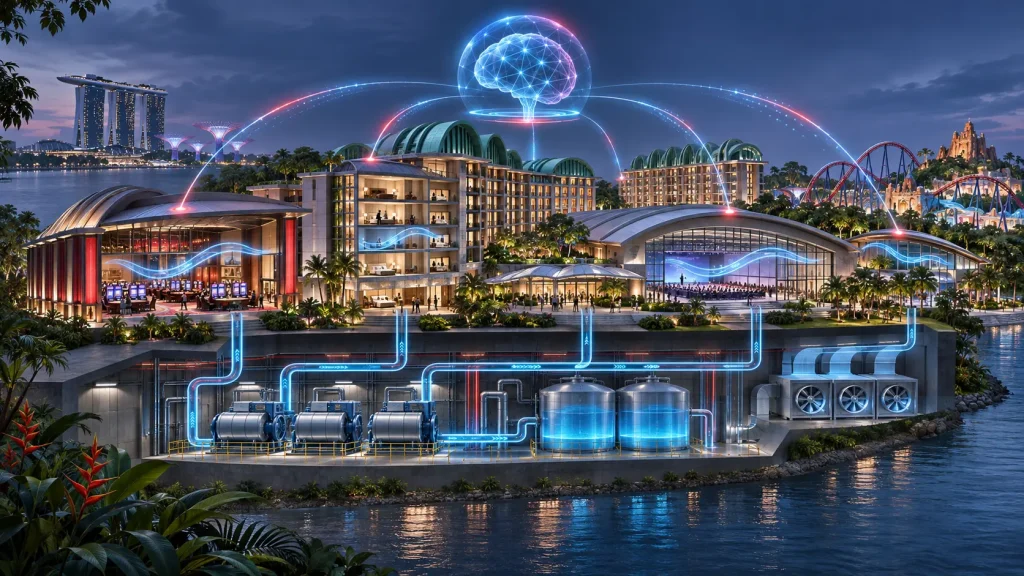
Resorts World Sentosa is extending its Honeywell building-automation partnership into predictive district cooling, using artificial intelligence to decide how much chilled water the Singapore integrated resort needs, which equipment should run and when.
The co-innovation programme, announced on 3 November, spans the resort’s two district cooling plants, venue air-conditioning and guest-room controls. RWS and Honeywell describe it as the first deployment of predictive optimisation for district cooling at a Singapore tourism destination.
Cooling becomes an operating platform
Honeywell Forge will combine occupancy, weather, historical operating data, alarms and maintenance information to forecast demand across the casino, hotels, Universal Studios Singapore, convention facilities and other parts of the precinct. The central plants have about 30,000 refrigeration tonnes of capacity and are connected to thermal storage tanks that hold chilled water for peak periods.
The district-cooling project targets annual savings of 2GWh. Separately, AI-based air-conditioning optimisation is already operating at Resorts World Convention Centre and Illumination’s Minion Land, where RWS expects energy reductions of 5% to 10%. A planned guest-room management layer across seven hotels is intended to cut room energy consumption by 20% to 30% by adjusting air-conditioning and other controls to room status and occupancy.
The programme builds on a large-scale cloud building-management system that the companies began deploying in 2023. Honeywell’s original partnership announcement framed the infrastructure as a decarbonisation and operating-efficiency project. The new layer moves from monitoring and automation toward forecasting and coordinated control.
Expansion raises the value of every saved unit
RWS currently uses about 186GWh of energy a year, according to details reported by Computer Weekly. The resort expects consumption to rise 28% over five years as new attractions and hotel capacity come online, while targeting a 15GWh to 20GWh reduction and a 36% to 40% improvement in energy-use intensity against its stated baseline.
Our view: this is not a peripheral sustainability story. Cooling is a large controllable cost in a tropical, 24-hour resort, and RWS is expanding into a period of higher power demand. Predictive optimisation can protect margins by absorbing more rooms, attractions and visitors without allowing energy consumption to scale linearly. The commercial test will be whether the promised savings persist across changing occupancy and event schedules—not whether the system can produce attractive dashboards.
For ASEAN integrated-resort and supplier developments, follow IGI’s Singapore market and Companies coverage.